

Japan Opens the 850 MHz Band for Wi-Fi HaLow: What It Means for Long-Range Video, Industrial IoT and Edge AI
Japan’s expansion of spectrum availability for Wi-Fi HaLow (IEEE 802.11ah) is creating new opportunities for long-range wireless connectivity. With the introduction of the 850 MHz band alongside the existing 920 MHz allocation, Wi-Fi HaLow can address a broader range of industrial and IoT applications, particularly those requiring continuous transmission and higher data throughput.
For applications such as video surveillance, industrial monitoring, smart agriculture, and Edge AI, this development could help overcome some of the limitations of conventional Wi-Fi networks.
AsiaRF is preparing for this market opportunity with a new portfolio of Japan-oriented Wi-Fi HaLow products, showcased at EdgeTech+ 2026 in Yokohama.
1. Japan’s New 850 MHz Band: What Has Changed?
Japan previously permitted Wi-Fi HaLow operation in the 920 MHz band in 2022. The addition of the 850 MHz band introduces a different operating environment with several important advantages.
The key differences include:
| Feature | 920 MHz Band | 850 MHz Band |
|---|---|---|
| Conducted transmission power | Up to 20 mW (13 dBm) | Up to 200 mW (23 dBm) |
| Duty-cycle restriction | 360 seconds per hour | No duty-cycle limit |
| Spectrum allocation | Shared with LoRa, Wi-SUN and RFID | Dedicated to Wi-Fi HaLow |
The higher permitted transmission power provides greater potential for extending wireless coverage, while the absence of a duty-cycle restriction allows continuous transmission.
Another important consideration is spectrum availability. Unlike the shared 920 MHz environment, the dedicated 850 MHz allocation offers a more focused spectrum environment for Wi-Fi HaLow deployment.
Together, these changes create new possibilities for applications that require sustained wireless communication rather than occasional sensor data transmission.
2. Why 850 MHz Matters for Video and Edge AI
Wi-Fi HaLow operates in sub-1 GHz frequency bands and is designed for long-range, low-power wireless connectivity.
Compared with conventional 2.4 GHz and 5 GHz Wi-Fi, its lower-frequency operation provides better propagation characteristics and helps wireless signals reach areas with obstacles, walls, and complex infrastructure.
The new 850 MHz operating environment could further expand its role in applications that require continuous data transmission.
Long-Range Video Surveillance
Video surveillance systems often need to cover large outdoor areas, industrial facilities, campuses, and infrastructure sites. Traditional Wi-Fi coverage can become challenging when cameras are distributed across long distances or separated by physical obstacles.
The 850 MHz band provides an opportunity to explore Wi-Fi HaLow for longer-range video connectivity, particularly where continuous transmission is required.
Industrial Monitoring and Automation
Factories and warehouses often contain distributed equipment, sensors, and monitoring systems. Wi-Fi HaLow can help connect existing industrial infrastructure through IP-based communication, reducing the need for extensive wired network deployment.
With its combination of long-range coverage and continuous transmission capability, the 850 MHz band offers additional flexibility for industrial wireless applications.
Edge AI and Intelligent Monitoring
Edge AI applications increasingly depend on collecting and transmitting data from distributed devices. Examples include intelligent surveillance, remote equipment monitoring, and localized data processing.
A wireless network capable of supporting longer-range connections and sustained data transmission can help create a more flexible infrastructure for these applications.
3. AsiaRF’s Wi-Fi HaLow Products for the Japanese Market
To support the expanding Wi-Fi HaLow ecosystem in Japan, AsiaRF is working with its Japanese distributor, Global Electronics Corporation (グローバル電子).
In November 2026, Global Electronics announced that it is handling AsiaRF Wi-Fi HaLow products.
At EdgeTech+ 2026, held at Pacifico Yokohama from November 18–20, three Japan-oriented products designed around the 850 MHz band were presented as reference exhibits.
AP7621-WH2: Multi-Function Industrial Gateway
The AP7621-WH2 is designed to connect industrial equipment and wireless networks through a single gateway platform.
Key features include:
- Wi-Fi HaLow connectivity
- Wi-Fi 6 wireless connectivity
- Ethernet and RS485 interfaces
- Planned 850 MHz / 920 MHz band switching for the Japan model
- Support for two LTE modules
By integrating multiple communication interfaces, the AP7621-WH2 is designed to help businesses connect existing industrial equipment while building a more flexible wireless network infrastructure.
AP7621-WH3: Outdoor Wi-Fi HaLow Gateway
The AP7621-WH3 is designed for outdoor wireless connectivity using Japan’s 850 MHz Wi-Fi HaLow band.
Key features include:
- 850 MHz Wi-Fi HaLow connectivity
- Wi-Fi 6
- Ethernet
- Functions designed for outdoor connectivity
Potential applications include agricultural facilities, campuses, and outdoor surveillance environments where wireless coverage needs to extend beyond conventional Wi-Fi deployment areas.
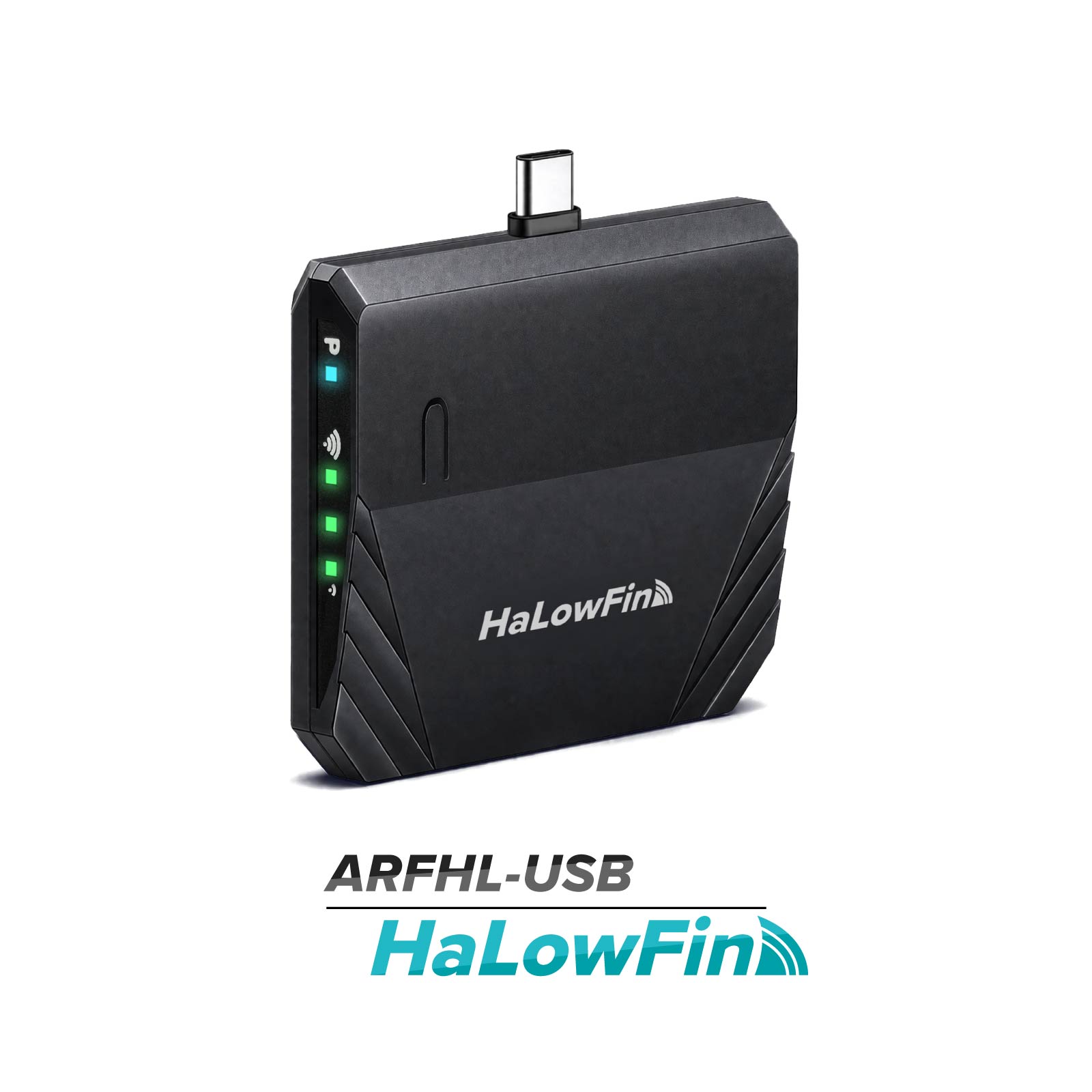
HaLowFin: Smartphone-Connected Wi-Fi HaLow USB Device
HaLowFin is a compact USB device designed to work with a smartphone to check Wi-Fi HaLow signal conditions in the field.
Key features include:
- Japan-oriented 850 MHz Wi-Fi HaLow support
- Built-in PCB antenna
- On-site wireless signal checking
It is intended to support field surveys, installation planning, and post-deployment maintenance, helping installers and system integrators evaluate wireless conditions at actual deployment locations.
4. Building a Complete Wi-Fi HaLow IoT Connectivity Solution
The three products address different stages of a wireless IoT deployment.
- AP7621-WH2: Connects industrial equipment and integrates multiple communication interfaces.
- AP7621-WH3: Extends Wi-Fi HaLow connectivity to outdoor environments.
- HaLowFin: Helps users evaluate signal conditions during installation and maintenance.
Together, they represent a broader approach to Wi-Fi HaLow deployment, covering long-range wireless communication, integration with existing equipment, external network connectivity, and on-site signal assessment.
This combination is particularly relevant to industrial facilities, smart agriculture, smart buildings, and infrastructure monitoring.
5. What Comes Next for Wi-Fi HaLow in Japan?
Japan’s expansion into the 850 MHz band represents an important step in broadening the potential applications of Wi-Fi HaLow.
Higher permitted transmission power, continuous transmission capability, and dedicated spectrum provide new opportunities for wireless solutions that require greater coverage and sustained connectivity.
For system integrators, equipment manufacturers, and IoT solution providers, the development opens new possibilities for designing wireless infrastructure beyond the limitations of conventional Wi-Fi.
AsiaRF will continue working with Global Electronics to develop and prepare its Wi-Fi HaLow product portfolio for the Japanese market.
Product availability and certification
The AP7621-WH2, AP7621-WH3, and HaLowFin products presented at EdgeTech+ 2026 are under development. Final Japanese specifications, technical-standard compliance, certification, and launch schedules have not yet been confirmed. Global Electronics plans to begin volume sales once the relevant technical requirements, product specifications, and supply arrangements are finalized.
For product inquiries, technical evaluations, and potential collaboration, please contact AsiaRF or our Japanese distributor, Global Electronics.
Learn more: AsiaRF Wi-Fi HaLow Products – Global Electronics
Sincerely,

CEO of AsiaRF